TL;DR
A high-conversion SaaS website wins with clarity, proof, and page paths that match buyer intent. Start with stronger structure, build beyond the homepage, use integration and persona pages, and measure every change against trial or demo conversion.
Most SaaS websites do not fail because the product is weak. They fail because the site asks a cold visitor to make a leap the page has not earned.
A high-conversion SaaS website does one job better than an average one: it reduces uncertainty fast enough that the right visitor keeps moving. That sounds simple, but in practice it changes how you write, design, structure, instrument, and ship the entire site.
Why most SaaS homepages lose the conversion before the product gets a chance
The biggest mistake I see is treating the website like a brand artifact instead of a sales surface. Teams spend weeks polishing visuals, then wonder why paid traffic bounces, demo intent stays flat, and sales says leads are unqualified.
A high-conversion SaaS website is not a prettier website. It is a clearer one with stronger proof and less friction.
That idea lines up with what Stan Vision describes as the real drivers of SaaS conversion: clarity, proof, and momentum. Not novelty. Not clever copy. Not motion for its own sake.
This matters more in 2026 because the funnel has changed. More buyers now discover brands through summaries, recommendations, and AI-generated answers before they ever land on your homepage. So the site has to do two jobs at once:
Be easy for humans to trust.
Be specific enough to be worth citing.
That is why vague positioning is expensive. If your homepage says you are an "all-in-one platform for modern teams," nothing sticks. AI tools cannot cite it cleanly. Buyers cannot repeat it internally. Sales cannot use it to qualify.
The sites that win tend to follow a simple pattern I use in audits: promise, proof, path, push.
Promise: what the product helps someone achieve.
Proof: why that claim should be believed.
Path: how the product fits the buyer's world.
Push: the next step with minimal friction.
If one of those is weak, conversions leak.
This is also where a lot of redesigns go wrong. Teams jump to visual execution before deciding which commercial problem the site needs to solve. Is the goal more self-serve trials? Better demo requests? Higher-intent paid traffic? Clearer qualification for enterprise buyers? Different answers require different page systems.
For founders and growth leads, this is the uncomfortable tradeoff: speed matters, but random speed creates expensive rework. A website redesign without a conversion thesis is just design debt with a launch date.
If the baseline is unclear, start there. Raze has written before about why many startup sites fail and why redesigns underperform when positioning and conversion logic are still fuzzy.
Start with the page architecture that earns attention instead of wasting it
A lot of teams try to solve conversion with isolated fixes. They rewrite the hero. Add logos. Swap screenshots. None of that helps much if the page sequence itself is wrong.
One useful structural reference comes from a Reddit framework on high-converting SaaS landing pages, which lays out a 9-section flow that starts with a hero and moves immediately into pain point or transformation language. That ordering matters because visitors are not asking, "Is this well designed?" They are asking, "Is this for me, and why should I care right now?"
In practice, the strongest homepage architectures usually include these core sections:
A hero with one clear promise and one clear CTA.
A pain, stakes, or transformation section right below the fold.
Product proof through visuals, workflow, or outcomes.
Trust signals such as customer logos, testimonials, or quantified claims when available.
Objection handling around implementation, integrations, security, or switching cost.
Deeper use cases or persona paths.
A CTA that matches buying intent.
That does not mean every site needs all nine sections from that community framework, in that exact order, on one page. It means the logic should be there.
The homepage should answer five silent questions
When I review a SaaS homepage, I look for five answers in the first minute:
What is this?
Who is it for?
Why is it better or different?
Can I trust it?
What should I do next?
If any answer is delayed, the page is making the visitor work.
A common pattern on weak pages is this sequence: vague hero, abstract product language, feature grid, then a CTA. That is backwards. The buyer has not seen enough evidence to deserve a CTA yet.
A stronger sequence goes like this: strong promise, clear buyer context, visual explanation, trust layer, then CTA. That is one reason Unbounce's review of SaaS landing pages keeps returning to essentials like USP, benefits, social proof, and a clean call to action.
Do not let the hero carry the entire sales motion
The hero matters, but it is usually overestimated.
I have seen teams spend ten rounds refining one line of copy while ignoring the sections that actually reduce risk. If your product has a non-trivial implementation, multi-person buying committee, or category confusion, the hero will never do all the work.
The hero should create forward motion, not close the deal.
That means your above-the-fold area should typically include:
A sharp headline tied to an outcome
A subhead that adds buyer context or mechanism
One primary CTA
A product visual that explains, not decorates
Optional lightweight proof if it supports the claim
If the page gets meaningful paid traffic, pair this with proper instrumentation in Google Analytics or your analytics stack so you can isolate hero CTA clicks, scroll depth, and downstream trial or demo completion. Without that, teams argue from taste.
For a deeper look at section order and messaging, this pairs well with our guide to high-converting SaaS websites and our landing page conversion breakdown.
Lesson 1 through 4: clarity, segmentation, integrations, and proof do the heavy lifting
Most of the conversion gain on a high-conversion SaaS website comes from four moves that are strategically boring and commercially powerful.
1. Say less, mean more
Clarity beats cleverness, especially in crowded markets.
The best pages cut jargon and compress the value proposition until a buyer can repeat it after one read. That sounds obvious, but many SaaS teams still hide behind category language because it feels safer than making a specific claim.
A useful contrarian rule here: do not write for everyone who could buy. Write for the person most likely to convert first. Broader language often lowers total conversion because nobody feels directly addressed.
This is one reason Stan Vision emphasizes clarity and momentum over aesthetic excess. A beautiful page that slows comprehension is underperforming, even if the brand team loves it.
2. Build beyond the homepage
A single homepage cannot carry every use case, persona, industry, and objection.
According to Grafit Agency's breakdown of high-converting SaaS pages, persona-specific and use-case pages are critical because they align the product story with what a particular buyer actually cares about. That matters when your audience includes, for example, both product leaders and revenue teams, or both startups and mid-market buyers.
This is where many early-stage SaaS companies hit a ceiling. They keep routing all traffic to one generic page, then blame traffic quality when conversion stalls.
Instead, create focused destination pages for:
Role-specific pain points
Industry or vertical context
Distinct use cases
Feature bundles tied to outcomes
Paid search intent clusters
If your CAC is rising, this is often a better investment than endlessly tweaking homepage design.
3. Show workflow fit, not just product features
Integration pages are often treated like SEO filler. That is a mistake.
As Grafit Agency notes, integration pages help conversion because they show how the product fits into the buyer's existing workflow. That is a trust and friction problem, not just a discoverability problem.
When a visitor sees that your product works with Slack, HubSpot, Salesforce, or Stripe, they are not just checking a feature box. They are estimating switching cost.
Strong integration pages usually answer:
What connects?
What data moves?
Who benefits?
How long setup takes?
What the workflow looks like after setup?
That last part matters. A logo grid is weak proof. A screenshot, workflow diagram, or short explanation of the before-and-after process is much stronger.
4. Put proof near the claim, not in a testimonial graveyard
Social proof works best when it supports a specific message in context.
A lot of sites dump testimonials into a carousel far below the fold. That is better than nothing, but not by much. If your headline makes a strong claim, the proof should sit close to it.
That can mean:
Customer logos under the hero
A customer quote next to the feature being discussed
A metric callout on a use-case page
A case-study CTA where buying skepticism peaks
Raze has covered this in a different way in our piece on customer stories. Buyers trust stories that sound like their own internal situation.
Lesson 5 through 7: study winners, borrow patterns, and instrument the site like a revenue asset
The goal is not to copy famous startup homepages. It is to understand why certain choices keep showing up on pages that convert.
Asana
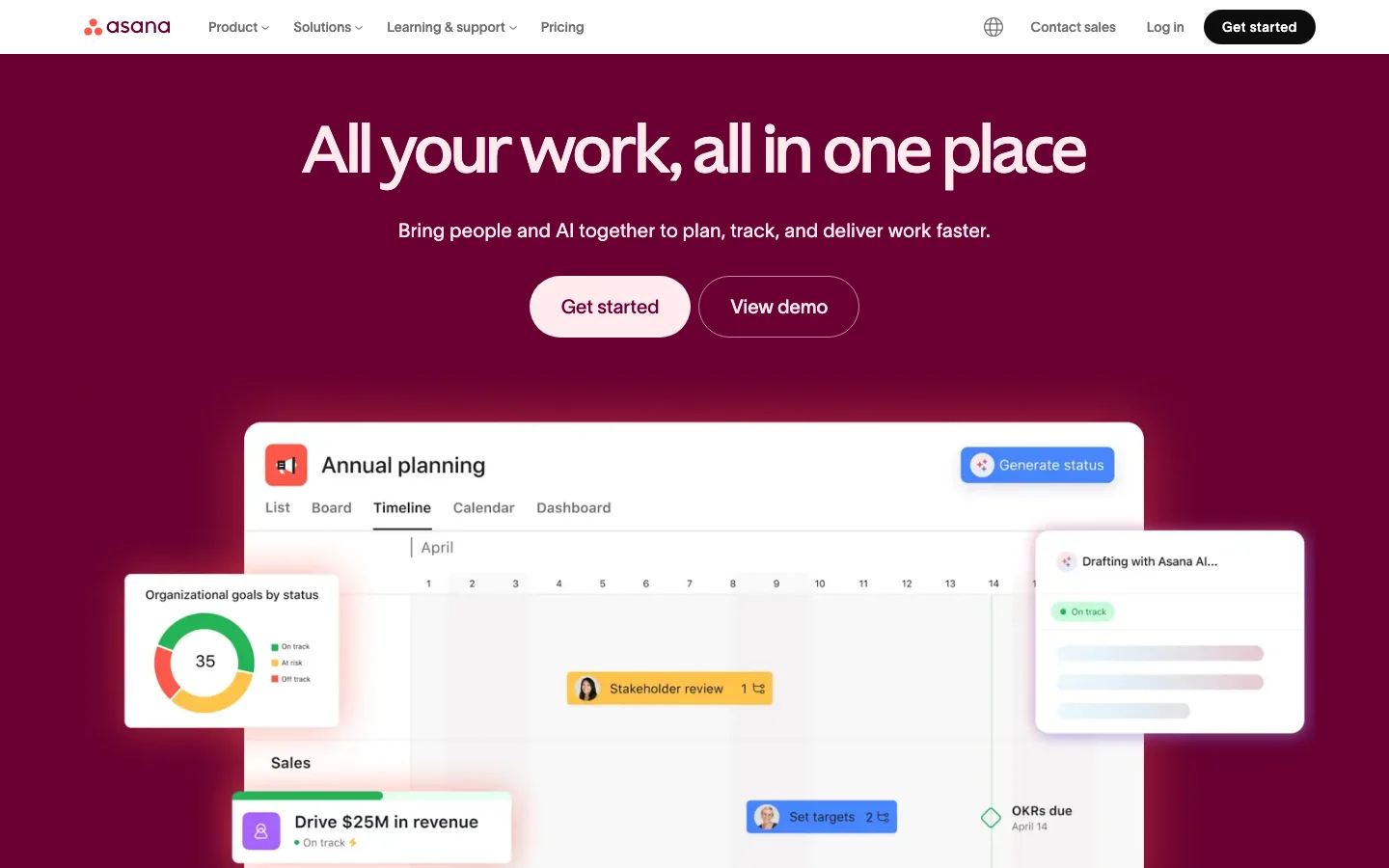
In KlientBoost's roundup of SaaS landing pages, examples like Asana show a pattern that appears again and again in high-performing SaaS: the product promise is visible quickly, the interface is easy to imagine using, and the CTA does not require much interpretation.
What is worth borrowing is not the styling. It is the compression.
Asana's kind of homepage pattern tends to do three things well:
It communicates category fast.
It makes collaboration or workflow value tangible.
It gives the visitor an easy next step.
If your site needs three paragraphs to explain what your product does, you are already behind.
Mixpanel
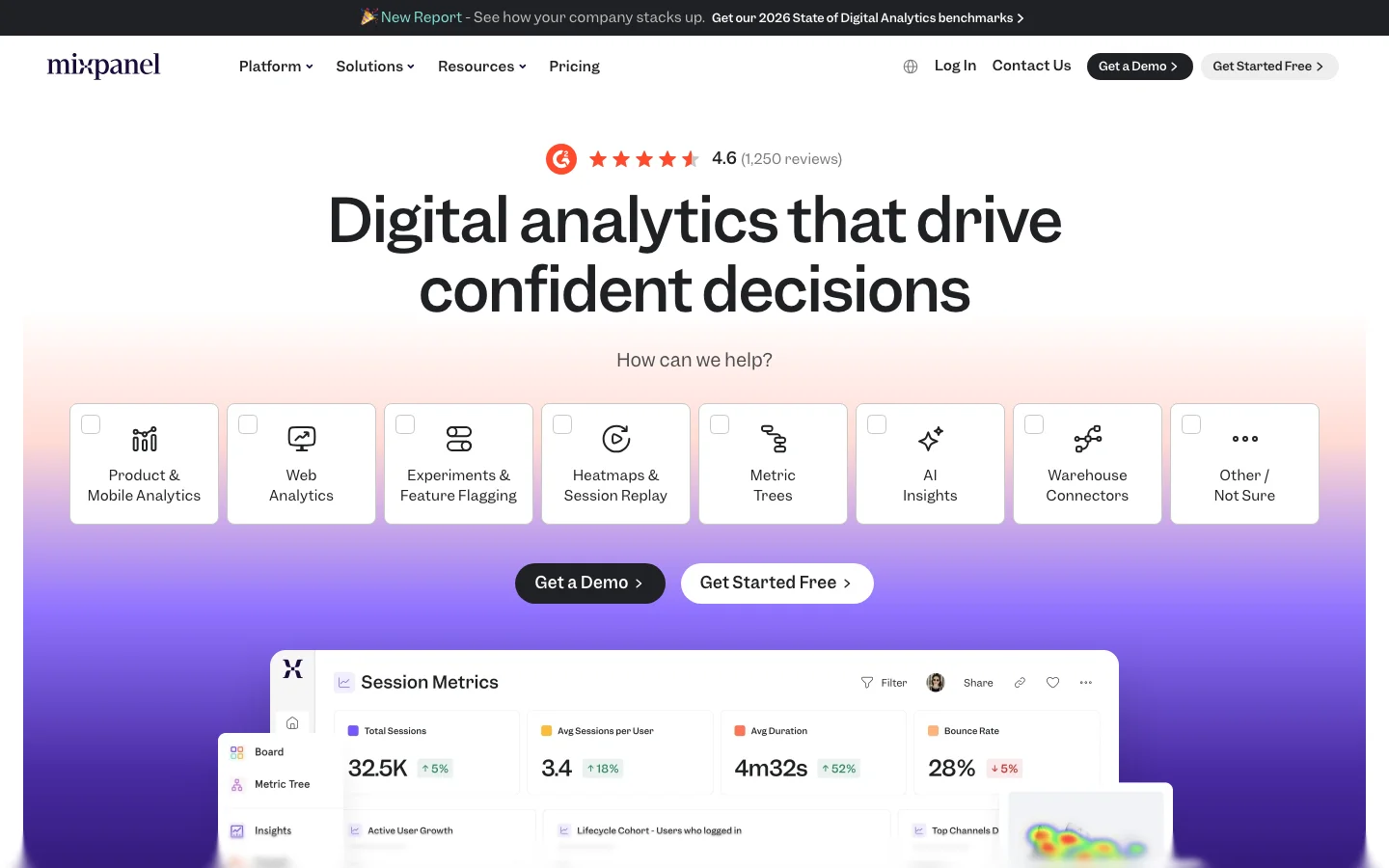
The same KlientBoost analysis points to examples like Mixpanel for another lesson: product-led SaaS sites often win when the interface itself acts as proof.
That matters for analytics, automation, and infrastructure products that can feel abstract in copy alone.
A screenshot is not enough by itself, but a well-chosen interface visual can answer two key questions quickly:
Is this product real?
Can I see myself using it?
That is why vague illustration-heavy sites often underperform in B2B SaaS. They may look modern, but they hide the actual product.
What 910 examples reveal about visual trust
There is also a broader pattern worth noting. The SaaS Landing Page gallery curates more than 910 examples, and the recurring visual direction is not loud creativity. It is clean, app-inspired interfaces, restrained color systems, and layouts that make product understanding easy.
That does not mean every page should look the same. It means buyers have learned to associate certain UI behaviors with competence and software maturity.
Webflow's 2025 roundup of SaaS website examples reinforces a similar pattern: the strongest sites feel modern, but they also reduce cognitive load. The page does not make you decode what matters.
The measurement stack that keeps redesigns honest
A redesign without measurement is mostly theater.
If I were rebuilding a high-conversion SaaS website from scratch, I would not launch without these basics:
Baseline homepage conversion rate to trial or demo
CTA click tracking by page section
Scroll depth and engagement events
Funnel segmentation by channel
Form completion rate and drop-off field analysis
Heatmap or session review for key landing pages
Tools vary. Google Analytics, Mixpanel, and Amplitude can all support pieces of this depending on your motion.
What matters is discipline. Define the baseline, define the target, define the timeframe, and isolate what changed.
If hard conversion data is thin, use a practical measurement plan instead of pretending certainty:
Baseline metric: current visit-to-trial or visit-to-demo rate
Target metric: percentage improvement by page type
Timeframe: first 4 to 6 weeks after launch
Instrumentation: analytics events, form tracking, and session reviews
That approach is far more useful than saying a redesign "felt better." If the page got prettier but demo quality dropped, the redesign failed.
For teams buying traffic, our guide on whether your website is ready for ads goes deeper on this handoff between conversion design and paid performance.
A practical rebuild checklist for teams under pressure to ship
Founders rarely get the luxury of a perfect rewrite. Usually the real question is what to fix first without slowing go-to-market.
This is the sequencing I would use.
1. Tighten the promise before touching the visuals
Rewrite the hero and subhead until a qualified buyer can understand the offer in one pass. If internal stakeholders all describe the product differently, stop there and fix that first.
2. Match each major traffic source to a page type
Do not send every visitor to the homepage.
Branded search might belong there. Paid search often does better on use-case or pain-point pages. Partner traffic may need integration pages. Mid-funnel retargeting often needs stronger proof assets.
3. Add proof at the point of skepticism
Put testimonials, trust badges, customer logos, or case-study links next to the claims that need belief. If you have no case studies yet, use product proof, setup clarity, or implementation detail instead of generic praise.
4. Build at least three page paths beyond the homepage
At minimum, create:
One persona page
One use-case page
One integration page
That simple expansion often reveals where messaging is too broad.
5. Remove CTA ambiguity
Frequently asked questions
How many pages does a high-conversion SaaS website actually need?
Most SaaS companies need more than a homepage but fewer pages than they expect. Start with a strong homepage, then add a persona page, a use-case page, and an integration page to support different buyer intents.
Should SaaS companies optimize for demos or free trials?
That depends on product complexity and sales motion. If the product needs explanation or stakeholder buy-in, demos usually work better. If time-to-value is fast and onboarding is simple, free trials can convert more efficiently.
How long should a SaaS homepage be?
A homepage should be long enough to resolve uncertainty for the buyer you want most. Simpler self-serve products can stay short, while more complex B2B products usually need more proof, workflow explanation, and objection handling.
Is it better to redesign the whole site or optimize page by page?
Page-by-page optimization is often safer when positioning is still evolving. A full redesign makes more sense when the brand, messaging, and conversion flow are all misaligned and need to be rebuilt together.
What should teams measure after launching a redesign?
Track visit-to-trial or visit-to-demo rate, CTA clicks by section, form completion, bounce by channel, and conversion by page type. Also watch lead quality so a higher conversion rate does not hide lower-intent pipeline.
Final takeaway
A high-conversion SaaS website wins with clarity, proof, and page paths that match buyer intent. Start with stronger structure, build beyond the homepage, use integration and persona pages, and measure every change against trial or demo conversion.